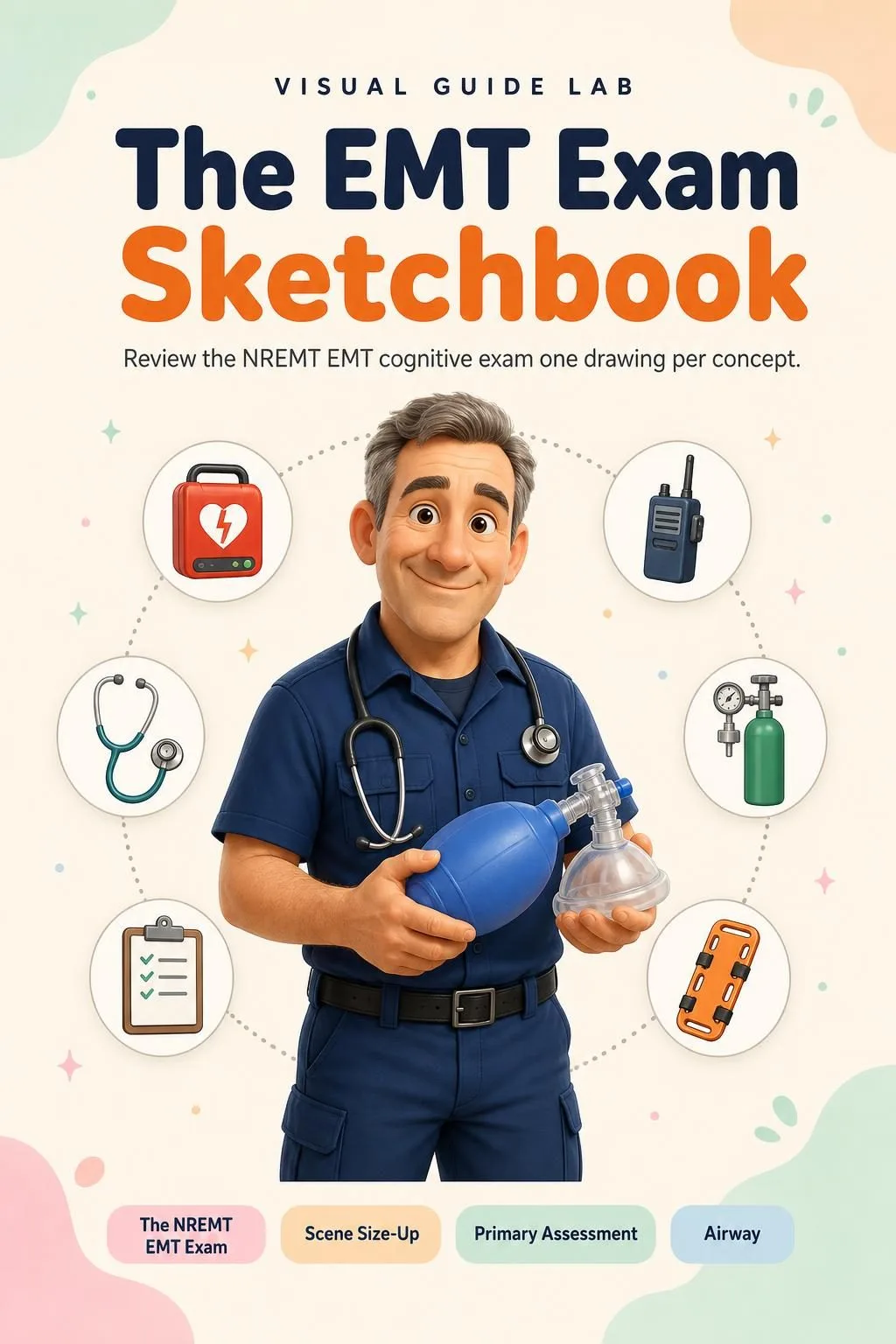
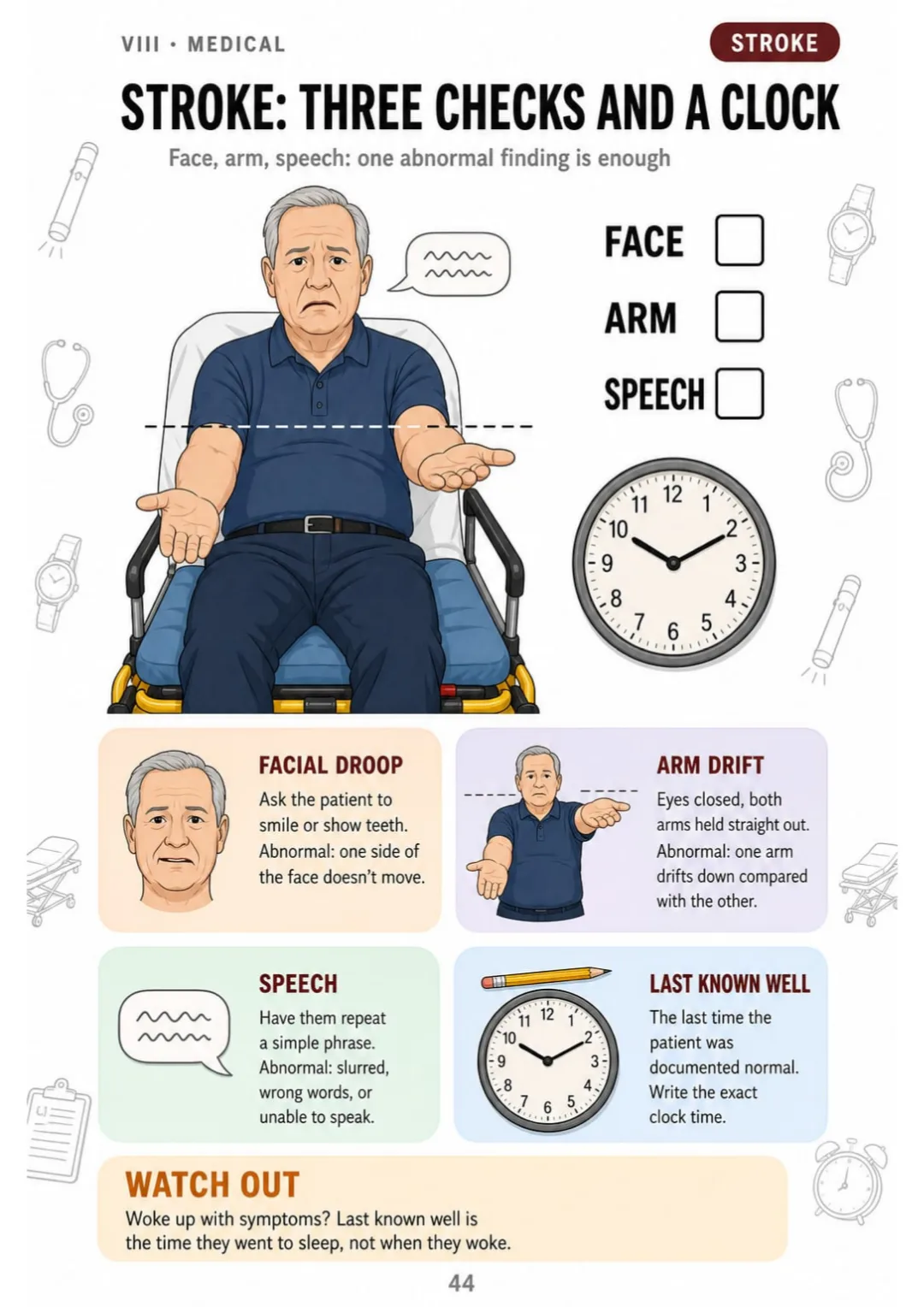
Scene safety, the primary assessment, airway, shock, CPR, SAMPLE, stroke, burns and triage: in your notes it's a wall of text. Here each topic fits on one page, with the drawing and what you need to remember. 66 illustrated pages.
🔒 Secure checkout · PDF by email · 30-day guarantee
One topic per page, the drawing that shows you how it's done and the boxes with what you need to know:


Swipe to see more →
These are real pages from the book. The table of contents is the full one: 11 parts and 62 topics.
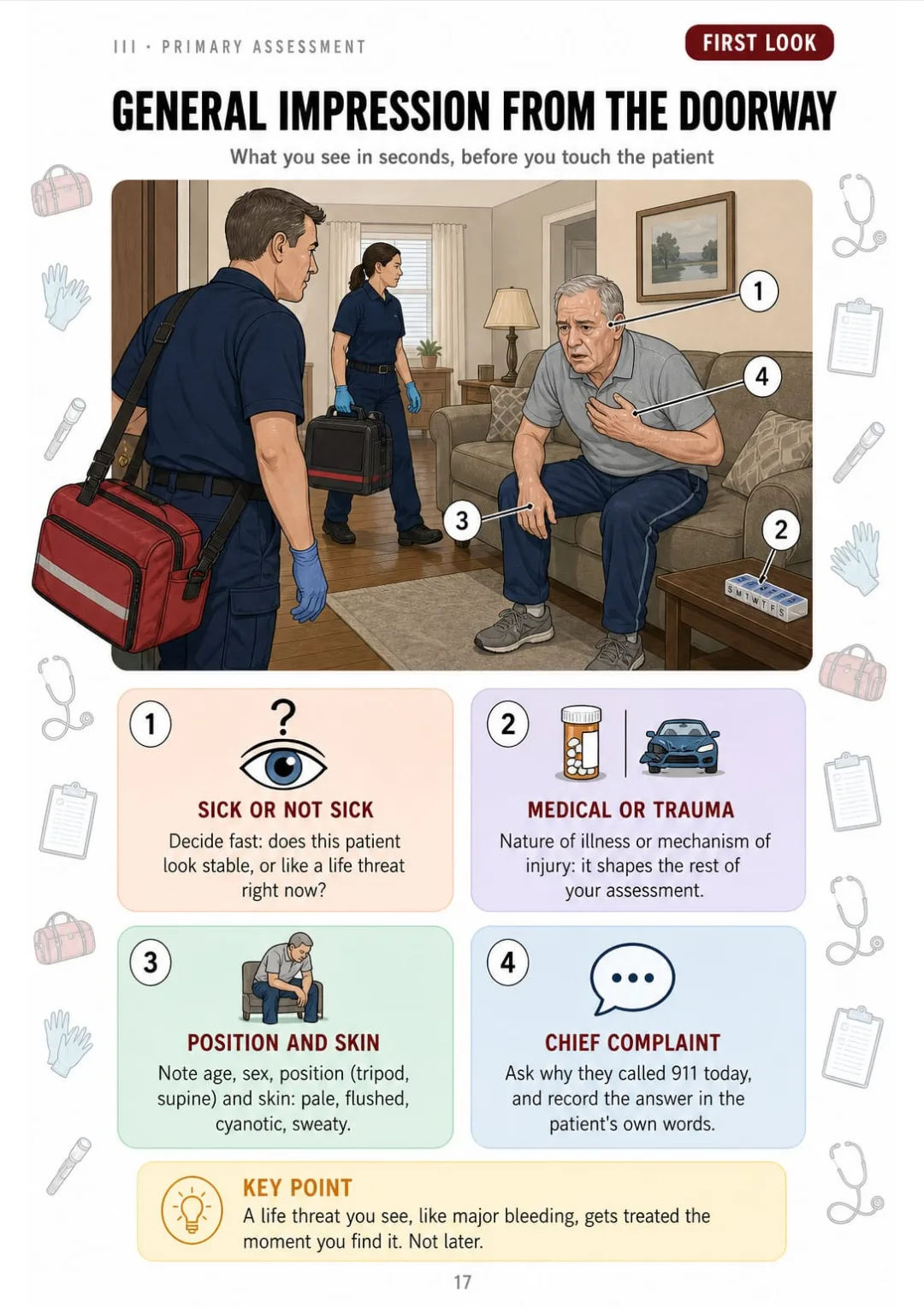
You've read the part on the general impression three times. You close the textbook...
...and you can't remember what you check first from the doorway. It was just lines of text.

Here the general impression is a drawn sequence, one look after another: sick or not sick, medical or trauma, position, skin, then the chief complaint.
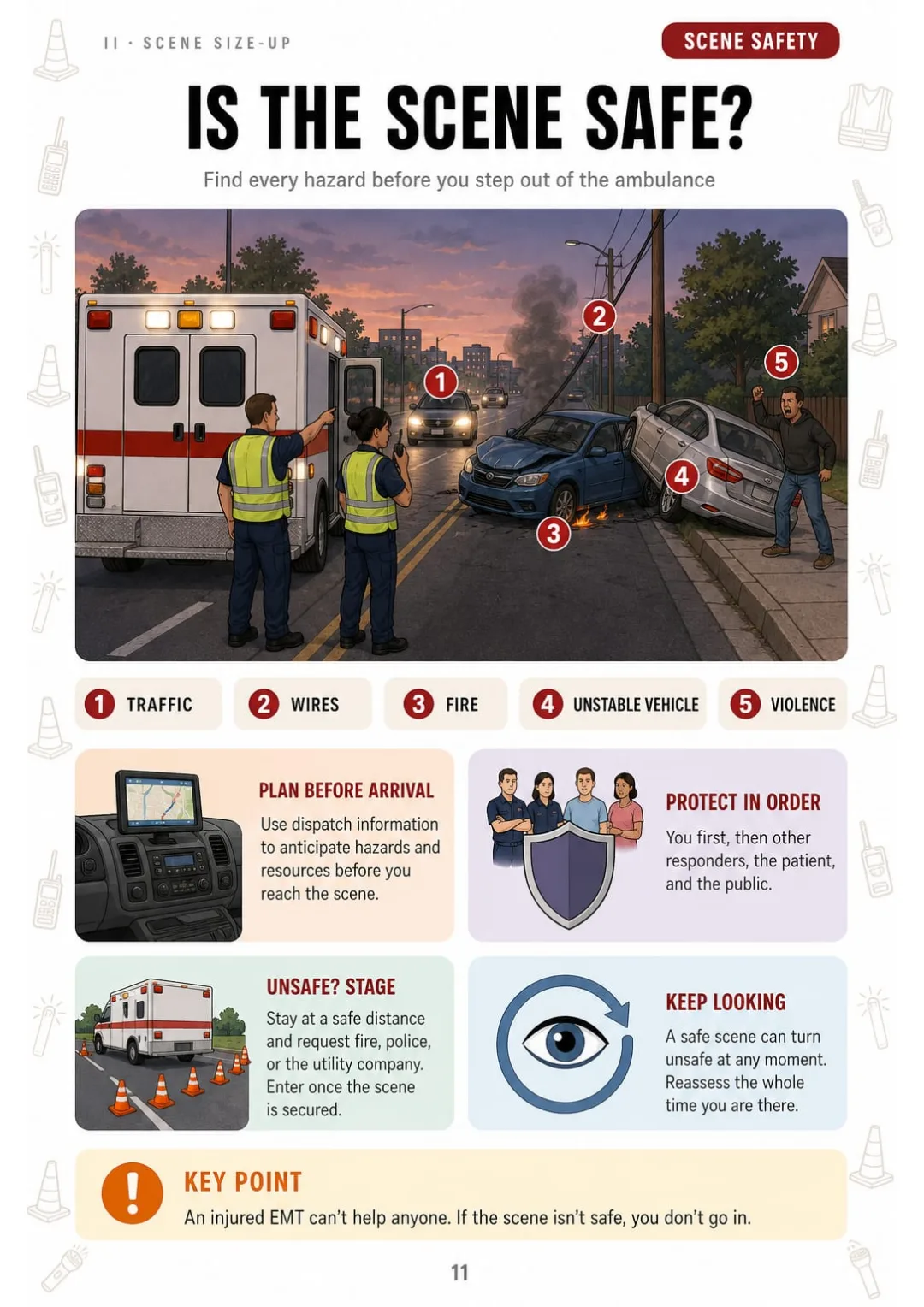
And on the pages next to it every flow gets its own: scene safety, AVPU, airway to circulation, SAMPLE and the transport decision.
First you understand why it's done that way. Then the order comes back to you on its own.

The exam, scene size-up, the primary assessment, airway and breathing, circulation and shock, cardiac arrest, the secondary assessment, medical and trauma calls, special populations and operations: one topic per page, all illustrated
Imagine this:
Instead of rereading half a page on the types of shock without being able to picture them...
...you open the page and find the shock types side by side in one table, with the skin, the pulse and what's behind each one.

And START triage, the Glasgow Coma Scale, the Chain of Survival, the Cincinnati scale and the adult rule of nines turn into drawings and tables you read at a glance.
You stop repeating and start understanding.
That's exactly what The EMT Exam Sketchbook does. It's not “just another textbook.” It's 11 parts, one drawn topic per page, and at the end an exam day plan with the common traps. When you see it in order, the order is what you remember.
Because what your brain sees organized, it remembers.
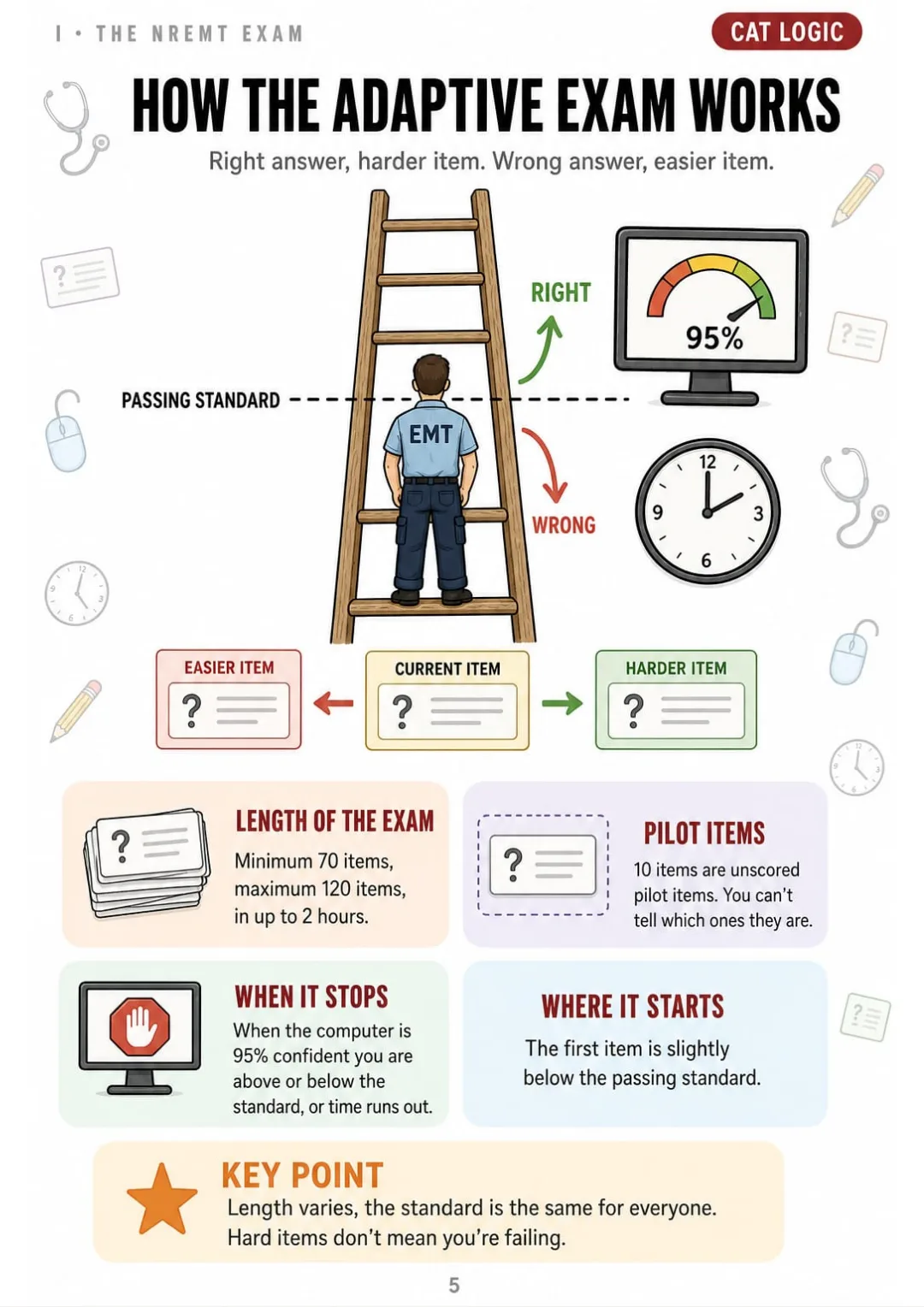
How the adaptive CAT exam works, the five content domains and their weights, the item types, eligibility and the ATT, results and retest rules, and national certification vs state license. You know what the exam looks like before you sit down.
Hazards before you enter, PPE matched to the hazard, mechanism of injury vs nature of illness, counting patients and calling for resources, and START and JumpSTART triage.
General impression and chief complaint, AVPU, the Glasgow Coma Scale step by step, the flow from airway to circulation, and priority patients and the transport decision.
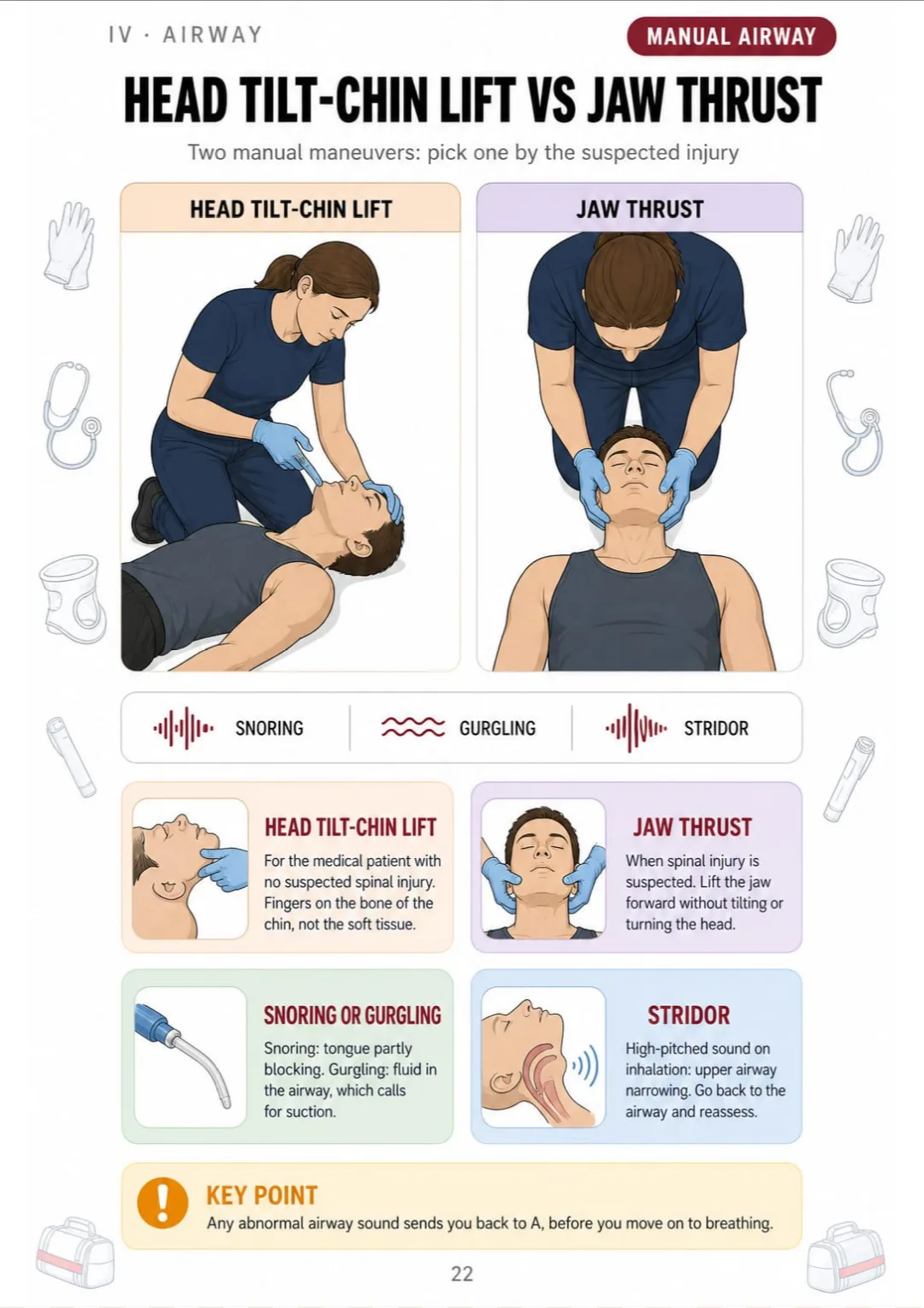
Head tilt-chin lift vs jaw thrust, sizing and inserting an OPA and an NPA, upper airway suctioning, oxygen devices within EMT scope, bag-mask ventilation and CPAP.
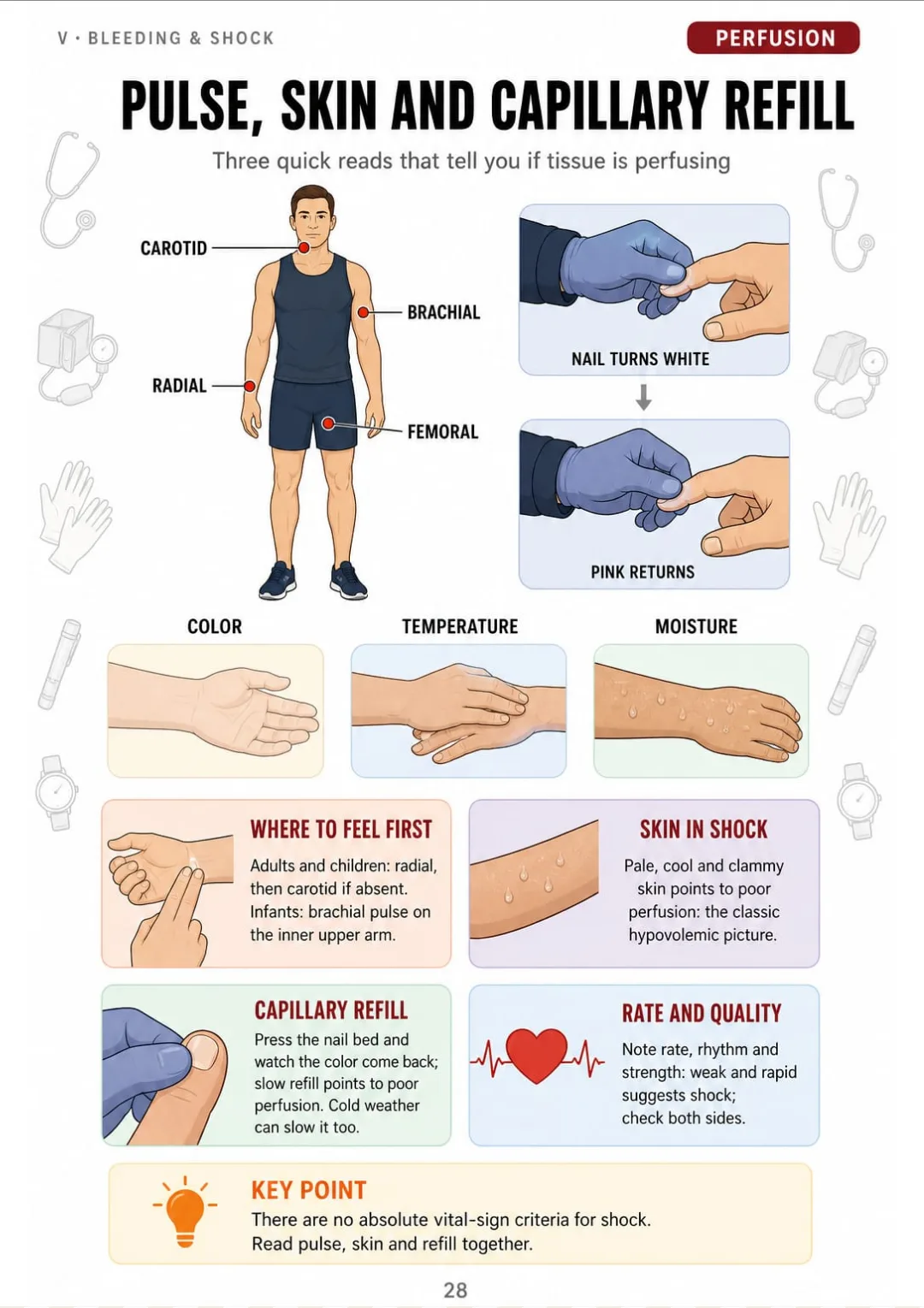
Pulse, skin and capillary refill, direct pressure, tourniquet and wound packing, neurogenic shock, compensated vs decompensated shock and anaphylaxis. The shock types sit side by side in one table, so you can tell them apart by skin and pulse at a glance.
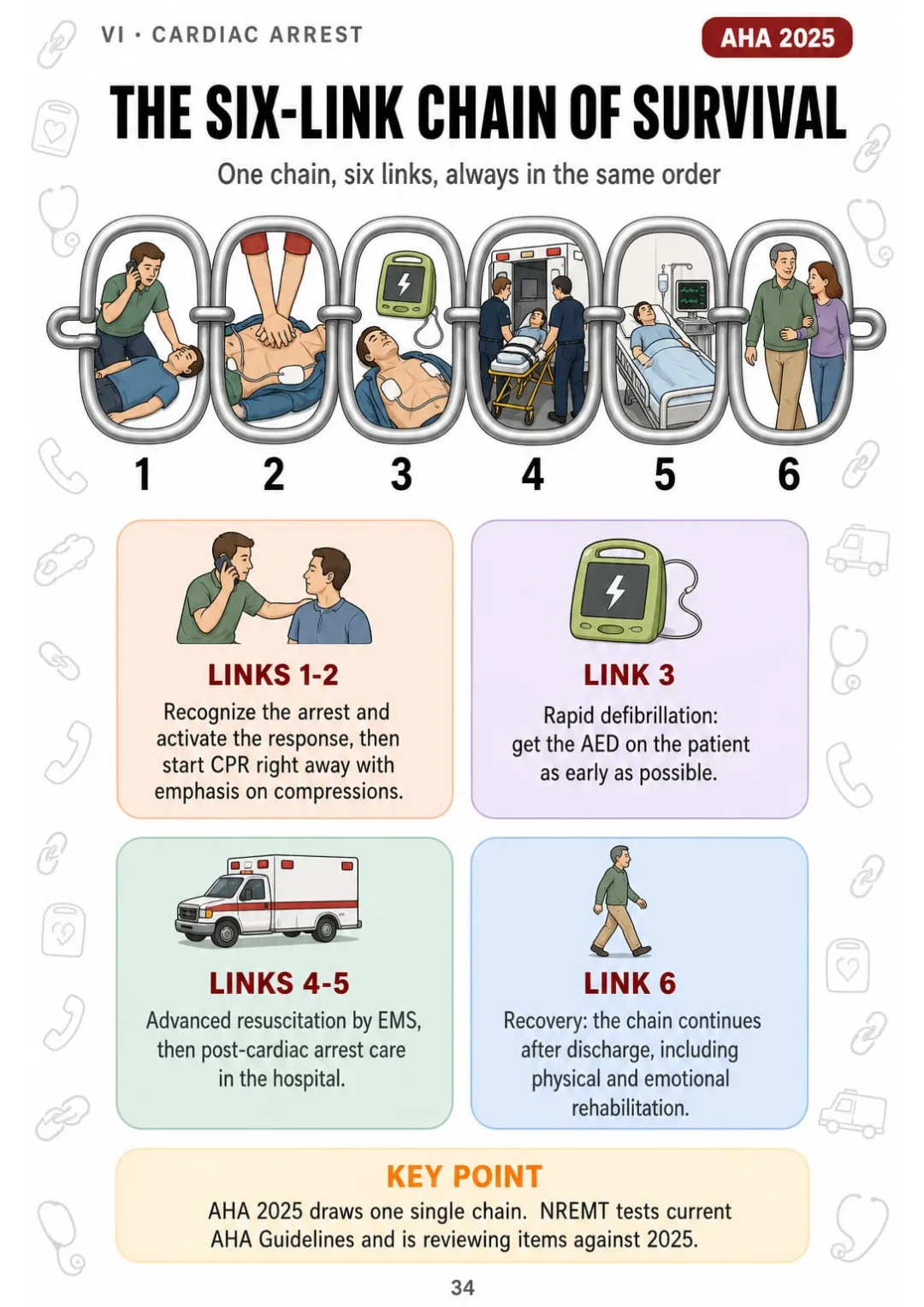
The six-link Chain of Survival, adult high-quality CPR, child and infant differences, the AED and short pauses, choking relief by age and breaths for a patient with a pulse.
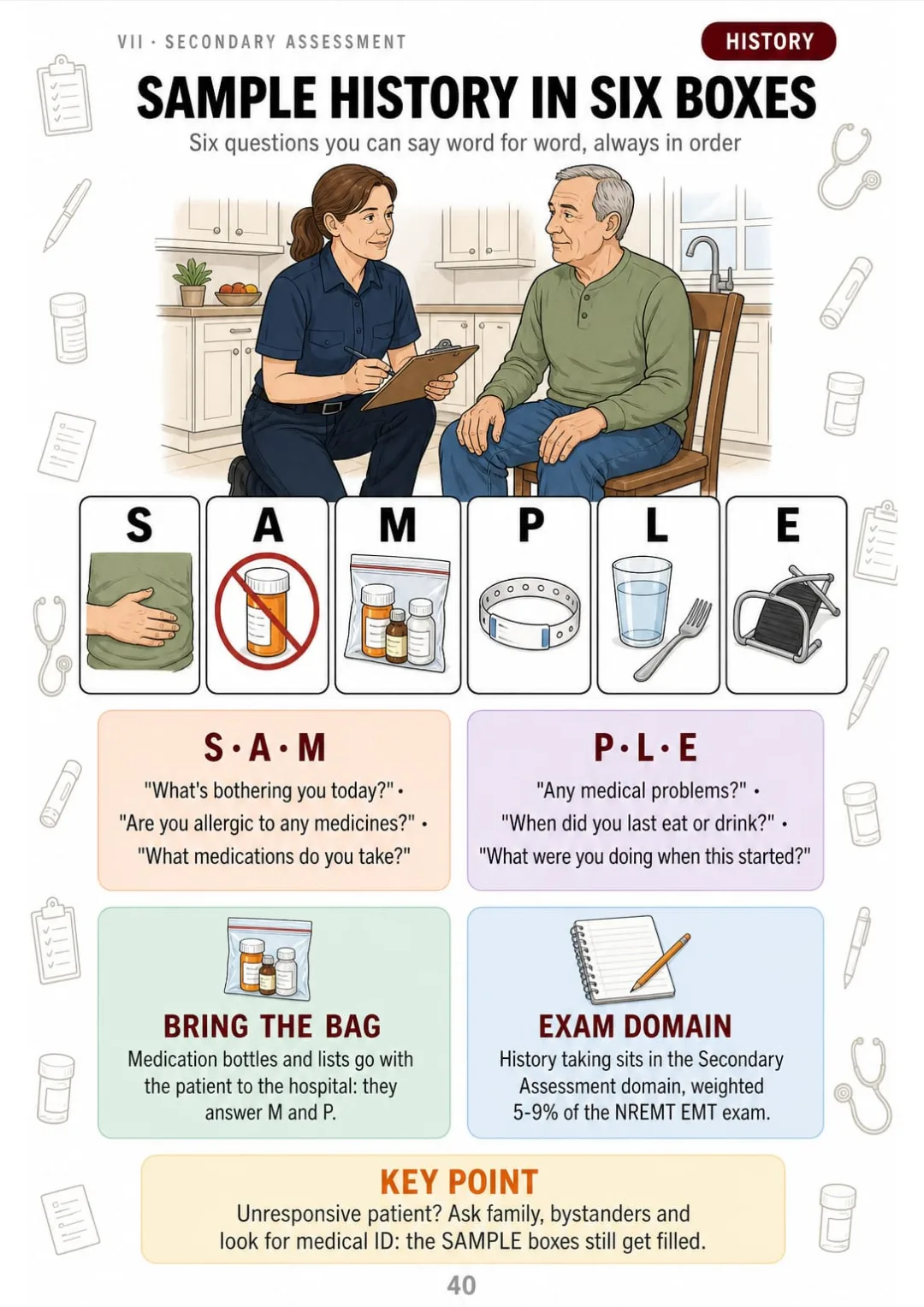
SAMPLE, OPQRST, baseline vital signs and reassessment, and when to do a focused exam or a full head-to-toe.
Stroke and last known well, chest pain, suspected hypoglycemia, wheezing, suspected opioid overdose and poisoning. Medications are only named: giving them always follows local protocol and medical direction.
Burn depth, the adult rule of nines, head injury and skull fracture signs, spinal motion restriction, chest injuries that compromise breathing and splinting.
Assisted childbirth step by step, the Apgar score at 1 and 5 minutes, airway differences in infants and children, children in distress and older adults.
Radio reports and hand-off, the patient care report, equipment checks, lifting and emergency moves, responder well-being, and your exam day plan with the common traps.
At the end of the book: How the adaptive exam works, the five item types and an exam day plan with the common traps.
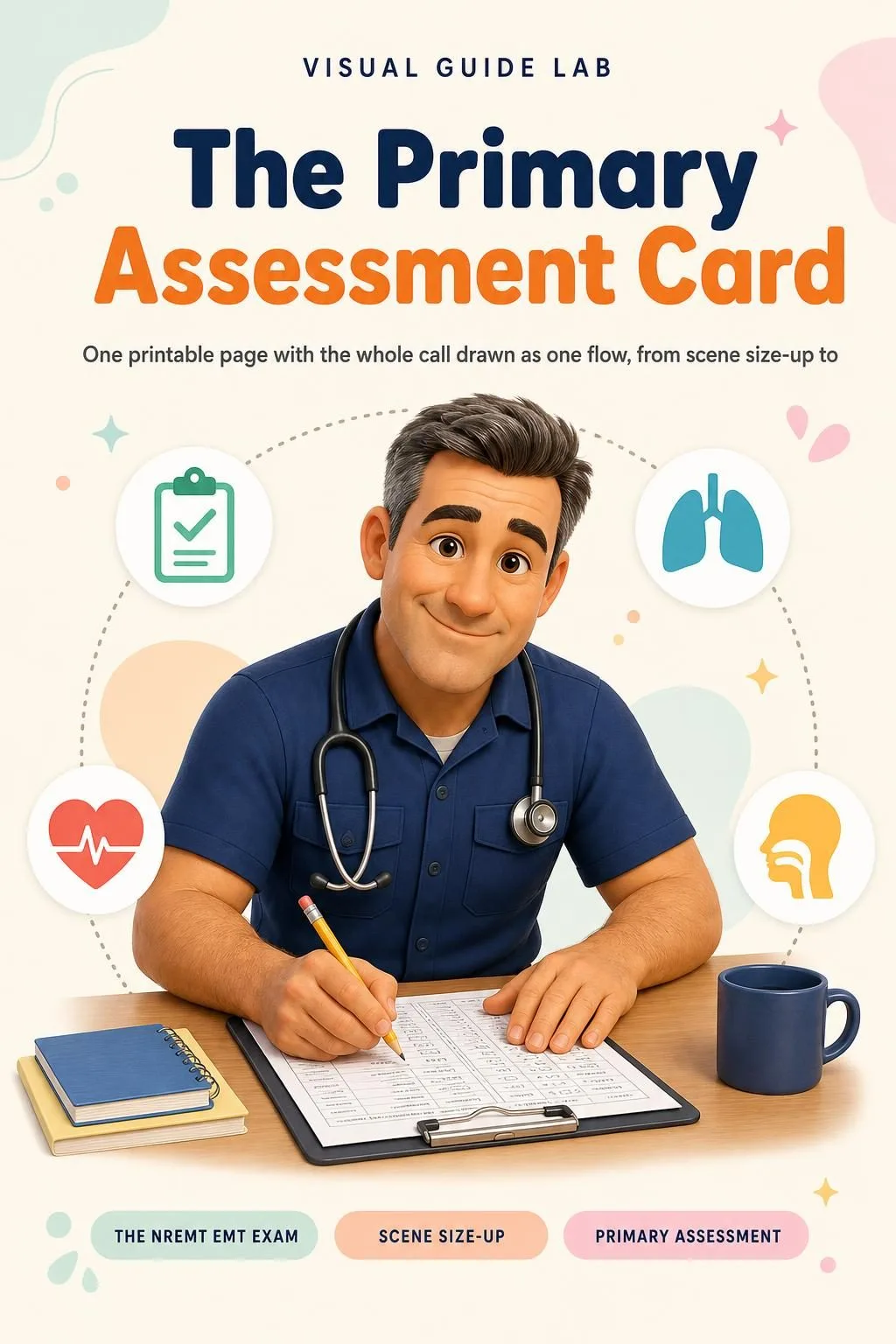
One printable page with the whole call drawn as one flow, from scene size-up to the transport decision, so you can review the order at a glance before every study session.

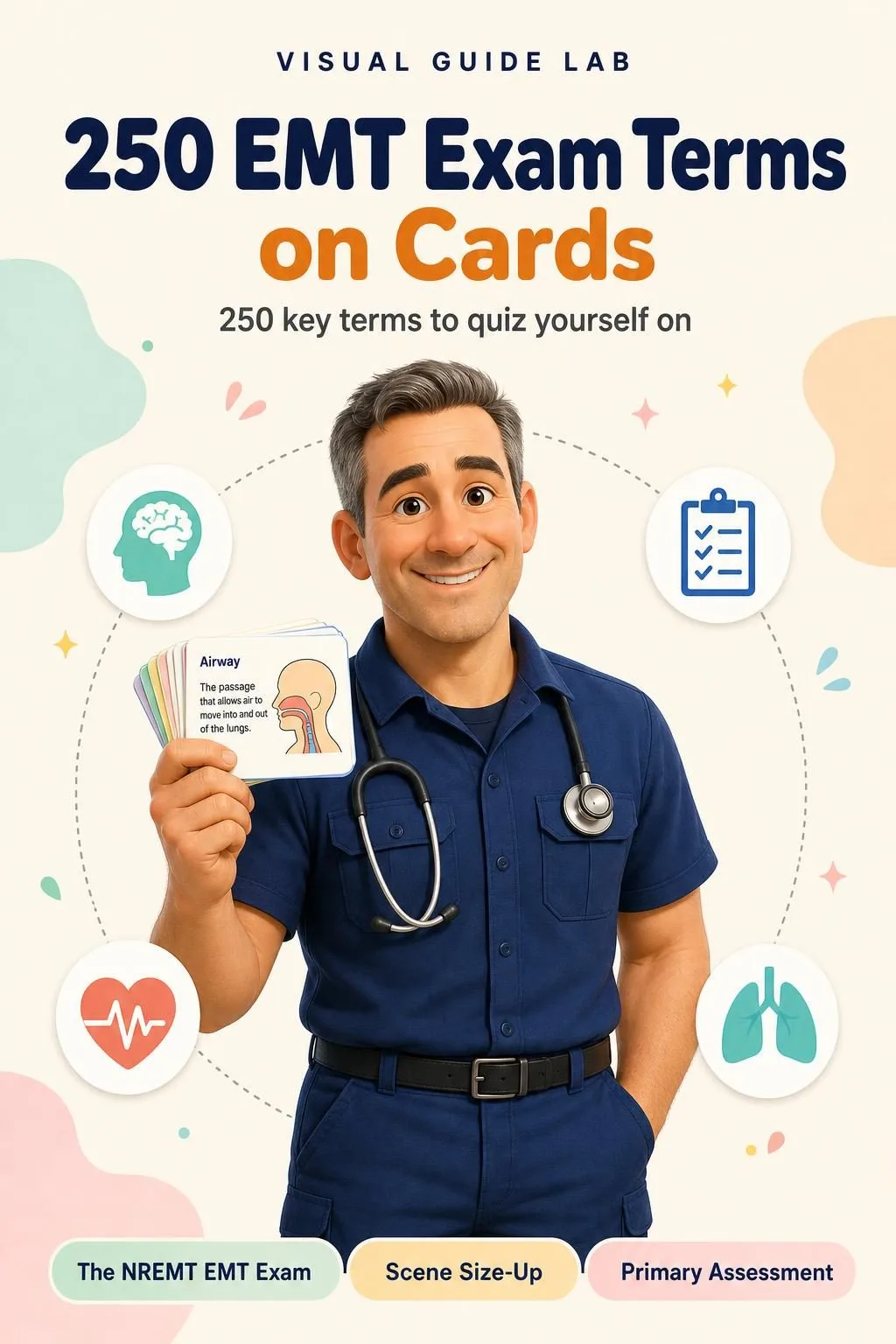
250 key terms to quiz yourself on: the term on the front, a one-line definition and a tiny sketch on the back, made to print and review in short breaks.
📄 This is a digital PDF book sent to your email: nothing is printed or shipped.
PDF by email: The EMT Exam Sketchbook reaches your inbox as a PDF, and the two free books come by email too. One-time payment, no installments or hidden costs.
Scene size-up, the primary assessment, airway and shock, one topic per page, to review between night classes and clinicals.
The whole exam reviewed in the order of the five current domains, plus how the adaptive exam works and an exam day plan. It works just as well if you're waiting to retest.
A quick review on the current test plan and the 2025 AHA Guidelines: the assessment order, CPR, triage and the shock types, side by side.
📄 This is a digital PDF book sent to your email: nothing is printed or shipped.
30-day guarantee: tell us what didn't work and we'll refund 100%.
You have 30 days to try The EMT Exam Sketchbook and both bonus books. If it doesn't work for you, tell us what didn't work and we'll refund 100% of what you paid. One-time payment, no subscription.
The EMT Exam Sketchbook comes as a high-resolution PDF by email, to the address you enter at checkout, so you can read it on your phone or print it. The two bonus books, The Primary Assessment Card and 250 EMT Exam Terms on Cards, also come by email.
One-time payment of US$ 37. No installments and no subscription.
For adults preparing for the NREMT EMT cognitive exam: if you're in a state EMT course, if your exam date is close, if you're waiting to retest, or if you're coming back to EMS after years away. It's a review, not a beginner's course. Check the table of contents above to see every topic.
On the NREMT EMT Examination Test Plan in effect since April 7, 2025 and the EMT Candidate Handbook; the National EMS Education Standards and the National EMS Scope of Practice Model 2019 (NHTSA); the 2025 AHA Guidelines for CPR and ECC; and CHEMM START/JumpSTART (HHS). Every number on a drawing matches the text and the source it names.
No. It's an independent study guide. It is not affiliated with or endorsed by the NREMT, Pearson VUE, NHTSA or the American Heart Association. It doesn't give you a certificate or continuing education hours: your certification comes only from passing the NREMT exams and meeting your state's requirements.
No. It's material for review. It doesn't replace a state-approved EMT course, skills training, local protocols or medical direction. And national certification is not a state license: your state decides that.
No. The book itself is not a question bank: it's 66 drawn pages to review every topic in order. If you add the optional EMT Practice Set at checkout, its 300 questions are original, written for this material, and are not official questions from any exam.
Yes. The PDF is high resolution, so you can print the whole book or just the pages you want to keep at hand.
You have 30 days. Tell us what didn't work and we'll refund 100%.
You don't have to reread the same page hoping it sticks this time.
You don't have to memorize assessment steps you can't picture.
And you definitely don't have to walk into the exam not knowing where to start.
One topic per page on the current test plan, two bonus books, a PDF by email you can print, and 30 days to tell us if it didn't work.
One-time payment: US$ 37 · Guarantee: 30 days · PDF by email
YES, I WANT THE EMT EXAM SKETCHBOOK FOR US$ 37📄 This is a digital PDF book sent to your email: nothing is printed or shipped.